

What Is an AI Agent?
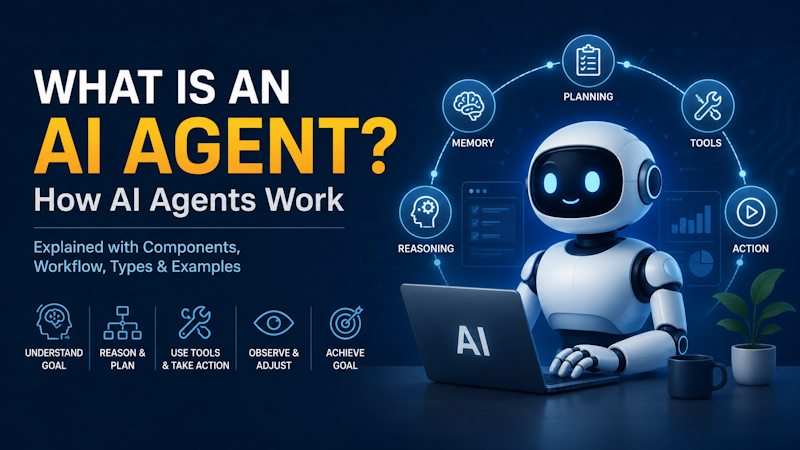
An AI agent is a software system that uses artificial intelligence to understand a goal, make decisions, and perform tasks on behalf of a user or another system.
Unlike a traditional chatbot that mainly responds to questions, an AI agent can often reason about a problem, create a plan, use external tools, perform actions, observe the results, and decide what to do next.
For example, imagine asking an AI system:
"Find the important customer complaints from this week's support tickets, categorize them, create a summary, and send the report to the support manager."
A basic AI assistant might explain how to perform those steps.
An AI agent could potentially complete the workflow by:
- Accessing the support system
- Retrieving recent tickets
- Analyzing the conversations
- Categorizing the problems
- Creating a summary
- Generating the report
- Sending or saving the report
The exact actions depend on the tools, permissions, and systems available to the agent.
This ability to move from simply generating information to taking actions toward a goal is one of the most important characteristics of AI agents.
For a broader look at autonomous AI systems, read our Agentic AI Complete Guide: AI Agents, How They Work, Use Cases and the Future.
How Do AI Agents Work?
Most modern AI agents operate through a repeating process involving understanding, reasoning, planning, action, observation, and adjustment.
A simplified AI agent workflow looks like this:
User Goal
    ↓
Understand the Request
    ↓
Reason About the Goal
    ↓
Create a Plan
    ↓
Select a Tool
    ↓
Perform an Action
    ↓
Observe the Result
    ↓
Evaluate Progress
    ↓
Continue / Adjust Plan
    ↓
Complete the Goal
Rather than generating one response and stopping, an agent can repeat parts of this process until the task is completed.
This iterative approach is commonly associated with patterns such as Reason → Act → Observe, where information returned by an action helps determine what the agent should do next.
Key Components of an AI Agent
Although AI agent architecture varies between platforms, most modern AI agents contain several important components.
1. AI Model
The AI model acts as the primary reasoning engine of the agent.
Modern agents are frequently powered by large language models (LLMs) that can understand natural-language instructions, analyze information, generate content, reason about tasks, and determine possible next actions.
The model alone, however, does not necessarily make an application an AI agent.
Agents become significantly more useful when the model is connected to other capabilities such as tools, memory, data sources, and orchestration.
2. Goals and Instructions
An agent needs to know what it is expected to accomplish.
The goal might come directly from a user:
Research five competitors and create a comparison report.
Developers can also provide system-level instructions defining how the agent should behave, which tools it can access, and what restrictions it must follow.
Clear goals and instructions help the agent determine the actions required to complete a task.
3. Reasoning and Planning
One of the key capabilities of advanced AI agents is their ability to break larger goals into smaller tasks.
Suppose you ask an agent:
Plan a three-day business trip and create my itinerary.
The agent might determine that it needs to:
Understand destination and dates
        ↓
Search available travel information
        ↓
Check accommodation options
        ↓
Review scheduled meetings
        ↓
Build the itinerary
        ↓
Present the final plan
Instead of requiring the user to provide every individual instruction, the agent determines the intermediate steps required to reach the goal.
For very simple tasks, extensive planning may not be necessary.
4. Tools
Tools are what allow an AI agent to do more than generate text.
Depending on its purpose, an agent could have access to:
- Search engines
- APIs
- Databases
- Email systems
- Calendars
- File systems
- Code execution environments
- CRM platforms
- Business applications
- Internal company services
- Other AI agents
For example, an AI model may understand that a user wants to schedule a meeting, but it cannot actually inspect a calendar unless the application gives it access to an appropriate calendar tool.
Tools therefore connect the agent's reasoning capabilities with external systems.
5. Memory
Memory helps an AI agent maintain useful information while completing tasks.
Short-Term Memory
Short-term or working memory maintains information relevant to the current interaction or workflow.
For example, an agent troubleshooting a technical problem might remember which diagnostic steps have already been completed.
Long-Term Memory
Some agents can also use persistent storage to retain selected information across interactions.
This could help an agent remember useful context, previous tasks, preferences, or information required for future workflows.
Not every AI agent requires long-term memory, and memory should be designed carefully to address security and privacy requirements.
6. Knowledge and Grounding
AI agents often need information beyond what exists in the underlying model.
They can retrieve information from sources such as:
- Company documents
- Knowledge bases
- Databases
- Vector databases
- Product documentation
- Search systems
- Real-time APIs
Retrieval-Augmented Generation (RAG) is one common technique for supplying relevant external information to an AI application.
Grounding an agent with trusted information can improve the accuracy and relevance of its decisions.
7. Orchestration
The orchestration layer coordinates the different parts of the AI agent workflow.
It can manage:
- Agent state
- Task execution
- Model requests
- Tool selection
- Tool calls
- Memory
- Data retrieval
- Error handling
- Workflow transitions
For multi-step tasks, orchestration determines how the agent moves from one action to another.
A Simple AI Agent Example
Imagine an AI customer support agent receives this request:
"My order hasn't arrived. Can you check what happened?"
A possible workflow could be:
Step 1: Understand the Request
The agent identifies that the customer wants information about a delayed order.
Step 2: Gather Information
It determines that it needs the relevant order information.
Step 3: Use a Tool
The agent queries the company's order-management system.
Step 4: Analyze the Result
It discovers that the shipment has been delayed by the delivery provider.
Step 5: Decide What to Do
Depending on company policy and its permissions, the agent might retrieve the latest tracking information or determine whether escalation is required.
Step 6: Take Action
The agent could provide the updated delivery information or create a support ticket for a human employee.
Step 7: Confirm the Outcome
The agent reports what happened and what action was taken.
This illustrates the fundamental idea behind how AI agents work:
Understand → Reason → Act → Observe → Adjust → Complete
AI Agent vs Traditional Chatbot
AI agents and traditional chatbots can both communicate with users, but they are designed differently.
| Feature | Traditional Chatbot | AI Agent |
|---|---|---|
| Answer questions | Yes | Yes |
| Understand natural language | Often | Yes |
| Reason about tasks | Limited | Typically |
| Create multi-step plans | Usually limited | Can |
| Use external tools | Sometimes | Common |
| Perform actions | Limited | Yes, when authorized |
| Maintain task state | Limited | Can |
| Adapt workflow | Limited | Can |
| Goal-oriented execution | Usually limited | Core capability |
A chatbot is primarily designed around conversation.
An AI agent is primarily designed around achieving a goal.
However, the boundary is becoming less obvious because modern AI assistants increasingly include agent-like capabilities.
AI Agent vs Generative AI
Generative AI and AI agents are also related but not identical.
Generative AI primarily focuses on creating new content such as:
- Text
- Images
- Audio
- Video
- Code
An AI agent can use generative AI as part of a larger system that reasons, makes decisions, accesses tools, and performs actions.
For example:
Generative AI:
"Write an email announcing our new product."

AI Agent:
"Review the product information, identify the customer segment,
draft the announcement, create the campaign in the authorized
marketing system, and prepare it for approval."
The second workflow requires more than content generation. It involves planning, tool use, and action.
AI Agents vs Agentic AI
The terms AI agents and agentic AI are closely connected.
An AI agent usually refers to an individual software system capable of pursuing a goal and taking actions.
Agentic AI is a broader concept describing AI systems designed around autonomy, reasoning, planning, tool use, and goal-directed action.
A sophisticated agentic system may contain several AI agents working together.
You can learn more in our detailed Agentic AI Complete Guide.
Types of AI Agents
There are several ways to categorize artificial intelligence agents. In modern generative AI applications, some common categories include:
Reactive Agents
Reactive agents respond to current inputs or events without extensive planning or long-term memory.
Goal-Based Agents
These agents make decisions based on a defined objective and select actions that move them toward that goal.
Learning Agents
Learning agents can use feedback, historical information, or other learning mechanisms to improve their performance.
LLM-Based Agents
LLM agents use large language models as their reasoning engine and may combine them with tools, APIs, memory, retrieval systems, and orchestration.
Multi-Agent Systems
A multi-agent system uses multiple specialized agents that communicate or collaborate to solve a larger problem.
For example:
Research Agent
      ↓
Analysis Agent
      ↓
Writing Agent
      ↓
Review Agent
Each agent can specialize in a particular part of the overall workflow.
Real-World AI Agent Examples
AI agents can potentially automate or assist with workflows across many industries.
Software Development
Coding agents can:
-
Analyze repositories
-
Generate code
-
Find bugs
-
Modify files
-
Run tests
-
Refactor applications
-
Assist with code reviews
Customer Support
Support agents can analyze customer questions, search knowledge bases, retrieve account information, categorize issues, and escalate complex cases.
Business Operations
AI agents can help automate repetitive workflows involving documents, databases, reports, approvals, and enterprise applications.
Research
Research agents can search multiple information sources, organize findings, compare evidence, and generate structured reports.
IT Operations
AI agents can help investigate system alerts, analyze logs, execute approved diagnostic tools, recommend fixes, and automate selected remediation workflows.
Personal Productivity
AI assistants with agent capabilities can help manage calendars, organize information, summarize documents, research topics, and automate routine tasks.
Benefits of AI Agents
The growing interest in AI agents and agentic AI comes from their potential to automate tasks that previously required many manual steps.
Major benefits include:
-
Automation of multi-step workflows
-
Reduced repetitive manual work
-
Faster information retrieval
-
Ability to interact with multiple systems
-
More flexible automation than rigid rule-based workflows
-
Improved developer productivity
-
Scalable customer support
-
Continuous operation for appropriate tasks
The biggest advantage is not simply generating better answers. It is the ability to connect reasoning with action.
Challenges and Limitations of AI Agents
AI agents also introduce important challenges.
Reliability
AI models can misunderstand instructions or generate incorrect conclusions.
Security
Giving an AI system access to APIs, databases, files, email, or production infrastructure creates additional security risks.
Permissions
Agents should receive only the permissions required to complete their intended tasks.
Incorrect Actions
An incorrect chatbot response may be inconvenient.
An incorrect autonomous action could have much greater consequences, particularly when an agent can modify data, send communications, execute code, or make transactions.
Cost
Complex agent workflows may require multiple model calls, searches, tool executions, and retries, increasing operating costs.
Observability
Organizations need visibility into what an agent did, which tools it used, and whether the final outcome was correct.
For sensitive or high-impact workflows, human approval and appropriate guardrails remain important.
Are AI Agents Fully Autonomous?
Not necessarily.
AI agents can operate at different levels of autonomy.
Some may only recommend actions and wait for human approval.
Others can automatically execute low-risk tasks while requesting approval for sensitive actions.
For example:
Low-Risk Action
      ↓
Execute Automatically

High-Risk Action
      ↓
Request Human Approval
      ↓
Execute if Approved
The appropriate level of autonomy depends on the application, risk, security requirements, and consequences of an incorrect action.
The Future of AI Agents
AI agents are moving AI applications beyond simple question-and-answer experiences toward systems capable of completing larger workflows.
The important shift is:
AI that generates
        ↓
AI that reasons
        ↓
AI that uses tools
        ↓
AI that takes actions
        ↓
AI that completes workflows
As agent technology improves, we are likely to see more AI agents integrated into software development, customer service, enterprise applications, research, IT operations, and everyday productivity tools.
Multi-agent architectures are also expanding the concept by allowing specialized agents to collaborate on larger tasks.
Frequently Asked Questions
What is an AI agent in simple terms?
An AI agent is a software system that uses artificial intelligence to understand a goal, make decisions, and take actions to achieve that goal. Modern AI agents commonly combine an AI model with tools, memory, data sources, and orchestration.
How do AI agents work?
AI agents typically receive a goal, analyze the task, determine the required steps, use available tools, observe the results, and continue adjusting their actions until the task is completed or requires human intervention.
What is an example of an AI agent?
An AI customer support agent could understand a customer's problem, retrieve order information, search a knowledge base, determine the appropriate response, update a support ticket, and escalate the issue when necessary.
Do AI agents use LLMs?
Many modern AI agents use large language models as their reasoning engine. However, AI agents can also incorporate other AI techniques, rules, machine learning models, tools, and specialized software components.
What is the difference between an AI agent and a chatbot?
A chatbot primarily focuses on interacting with users through conversation. An AI agent is designed to pursue goals and can potentially plan tasks, use external tools, make decisions, and perform actions.
Can AI agents work together?
Yes. Multiple specialized agents can communicate and collaborate in a multi-agent system, with different agents handling different parts of a larger workflow.
Conclusion
An AI agent is more than an AI system that answers questions. It combines artificial intelligence with reasoning, planning, tools, memory, data, and actions to work toward a defined goal.
A typical AI agent receives an objective, determines what needs to be done, selects appropriate tools, performs actions, observes the results, and adjusts its approach until it reaches an acceptable outcome.
This ability to connect AI reasoning with real-world actions is what makes AI agents an important part of modern AI development.
As organizations adopt more agentic systems, understanding how AI agents work, AI agent architecture, tool use, memory, security, and human oversight will become increasingly important.
For a broader introduction to this technology and where it is heading, read our Agentic AI Complete Guide: AI Agents, How They Work, Use Cases and the Future.
Comments (0)