

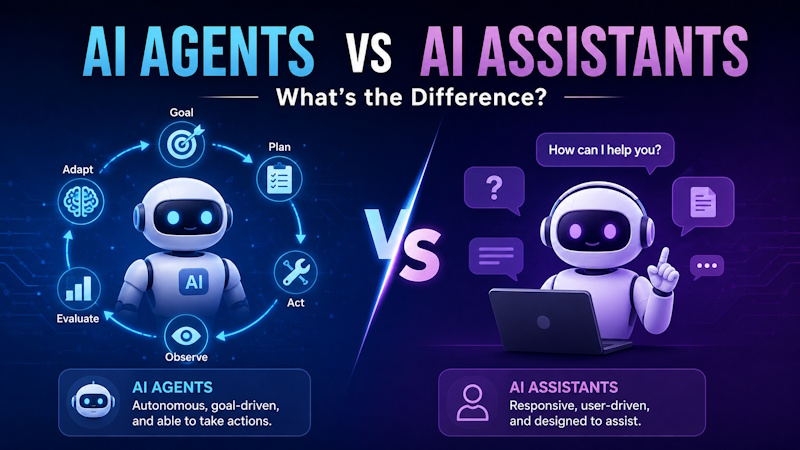
Artificial intelligence is moving beyond simple question-and-answer tools. Today, businesses and individuals increasingly use AI assistants to help with everyday tasks, while a newer generation of AI agents can take goals, make decisions, use tools and perform multi-step work with greater autonomy.
Because both technologies can be powered by large language models (LLMs), the terms are sometimes used interchangeably. However, they are not exactly the same.
The simplest distinction is:
An AI assistant primarily helps you perform a task, while an AI agent can be designed to pursue a goal and take actions on your behalf.
That difference becomes important as AI systems gain access to applications, APIs, databases, web services and other tools.
In this guide, we'll explain AI agents vs AI assistants, how each works, their key differences, practical examples, advantages and limitations, and when you might choose one over the other.
What Is an AI Assistant?
An AI assistant is an artificial intelligence system designed to help a user complete tasks, answer questions, generate content or provide recommendations.
Most AI assistants operate through user interaction. You provide a prompt or request, the assistant processes it and returns a response.
For example, you might ask an AI assistant to:
- Summarize a document
- Rewrite an email
- Explain a programming error
- Generate code
- Brainstorm marketing ideas
- Translate content
- Create meeting notes
- Research a topic
- Answer questions
The important point is that the user generally remains in control of the workflow.
A simplified AI assistant workflow looks like this:
User Request → AI Processing → Response → User Decision → Next Request
The assistant may have access to tools, memory or external information, but it typically works in response to the user's instructions.
What Is an AI Agent?
An AI agent is a software system that can work toward a defined objective by observing information, reasoning about what to do, selecting actions, using tools and evaluating the results.
Instead of requiring the user to specify every individual step, an agent may determine some of those steps itself.
A simplified agent workflow could look like:
Goal → Observe → Reason → Plan → Act → Evaluate → Repeat → Complete
Suppose you provide this goal:
“Research five competing project management platforms and prepare a comparison of their pricing and major features.”
An AI assistant might help you research each product as you provide individual prompts.
An AI agent could potentially break the objective into tasks such as:
- Identify relevant competitors.
- Search for current product information.
- Gather pricing and feature data.
- Compare the products.
- Identify advantages and limitations.
- Prepare a structured report.
- Check whether the original objective has been satisfied.
The agent may perform several of these steps before returning the final result.
For a broader introduction to this technology, see our guide to Agentic AI and AI Agents.
You can also read What Is an AI Agent and How Do AI Agents Work? for a deeper explanation of the underlying workflow.
AI Agents vs AI Assistants: Key Differences
Although the boundary is becoming less clear as AI assistants gain more advanced capabilities, the following comparison captures the practical differences.
| Feature | AI Assistant | AI Agent |
|---|---|---|
| Primary purpose | Help the user | Accomplish a goal |
| Interaction | Usually prompt-driven | Can execute multi-step workflows |
| Autonomy | Generally lower | Generally higher |
| Planning | Often limited or user-directed | Can create and adjust plans |
| Decision-making | User usually makes key decisions | Can make permitted decisions |
| Tool usage | May use tools when requested | Can select and use tools as part of a workflow |
| Multi-step tasks | Often guided by the user | Can coordinate steps automatically |
| Feedback loop | Usually relies on new user prompts | Can evaluate results and continue |
| Best suited for | Interactive assistance | Goal-oriented automation |
| Human involvement | Typically higher | Can be lower depending on permissions |
The distinction is therefore not simply about which system is “more intelligent.” It is primarily about autonomy, workflow and responsibility for deciding the next action.
Example: AI Assistant vs AI Agent
Consider a business owner who wants to understand customer feedback.
Using an AI Assistant
The workflow might be:
User: “Summarize these customer reviews.”
The assistant creates a summary.
User: “Identify the most common complaints.”
The assistant analyses the complaints.
User: “Create a report showing the top five issues.”
The assistant produces the report.
The AI is useful, but the human continues directing each stage.
Using an AI Agent
The user might instead provide a broader goal:
“Analyse this month's customer feedback and prepare a report highlighting the biggest problems requiring attention.”
An appropriately configured agent could:
Collect reviews → classify feedback → identify recurring problems → calculate trends → prioritize issues → generate report → deliver results
The user defines the objective, while the agent handles more of the workflow.
That is one of the clearest ways to understand the difference between AI agents and AI assistants.
How AI Assistants Work
Modern AI assistants are commonly built around an LLM.
A typical architecture may include:
User Interface → LLM → Context/Memory → Optional Tools → Response
The user provides instructions through an application or conversational interface. The model interprets the request and generates an appropriate response.
More advanced assistants may also access:
- Search engines
- Documents
- Company knowledge bases
- Databases
- Calendars
- APIs
- Code execution environments
- Business applications
Adding tools can make an assistant significantly more capable, but access to tools alone does not necessarily make the system an autonomous agent.
How AI Agents Work
AI agents generally introduce a stronger decision and execution loop.
A simplified architecture might include:
Goal → LLM/Reasoning → Planning → Memory → Tool Selection → Action → Observation → Evaluation
After performing an action, the agent evaluates what happened.
It may then decide:
- The objective is complete.
- More information is required.
- Another tool should be used.
- The previous approach failed.
- The plan needs to change.
- Human approval is required.
This ability to observe the outcome and decide what happens next is central to many agentic AI systems.
Autonomy Is the Biggest Difference
One of the most important SEO questions around AI agent vs AI assistant is whether an agent is simply a more advanced assistant.
In many practical systems, the answer is partly yes—but autonomy is the critical distinction.
Imagine three levels:
Level 1 – AI Assistant
“Write a follow-up email for this customer.”
The AI generates the email and waits.
Level 2 – Tool-Enabled AI Assistant
“Check the customer's previous messages and draft a follow-up.”
The assistant accesses permitted information and creates the draft.
Level 3 – AI Agent
“Follow up with customers who haven't responded within seven days.”
An agent could potentially identify qualifying customers, review their history, generate appropriate messages, request approval where required, send permitted communications and record the outcome.
The progression is essentially:
Answer → Assist → Act
However, these categories are not absolute. Modern AI products increasingly combine assistant-style interfaces with agentic capabilities.
AI Assistant Examples
Common applications of AI assistants include:
- Writing and editing
- Coding assistance
- Document summarization
- Question answering
- Meeting assistance
- Research support
- Data interpretation
- Customer-support assistance
- Knowledge retrieval
- Personal productivity
For example, a developer could ask an AI coding assistant:
“Explain why this API request is returning HTTP 401.”
The assistant can inspect the provided information, explain likely causes and suggest a solution.
The developer remains responsible for deciding what changes to make.
AI Agent Examples
AI agent use cases are typically more workflow-oriented.
Examples include:
Software Development Agents
An agent could inspect an issue, analyse a codebase, modify files, run tests and evaluate whether the change solved the problem.
Research Agents
A research agent could gather information from multiple sources, compare findings and create a structured report.
Customer Service Agents
An agent could classify requests, retrieve account information, propose or execute permitted actions and escalate unusual situations to a human.
IT Operations Agents
Agents can potentially analyse alerts, collect diagnostic information, execute approved remediation steps and verify whether a service has recovered.
Sales Agents
An agent might research prospects, update CRM information, prepare personalized outreach and schedule approved follow-up activities.
These workflows illustrate why autonomous AI agents are receiving significant attention in enterprise automation.
AI Agents vs AI Assistants vs Chatbots
AI assistants and AI agents are also frequently confused with chatbots.
A traditional chatbot typically follows predefined conversational rules or retrieves answers from an established knowledge base.
An AI assistant uses more sophisticated AI to understand natural-language requests and provide flexible assistance.
An AI agent goes further by being able to reason about goals and take actions across multiple steps.
A useful simplified progression is:
Chatbot → answers
AI Assistant → helps
AI Agent → acts
There are exceptions, however. A chatbot interface can contain an AI assistant, and an AI assistant can include agentic capabilities.
For a more detailed comparison, read AI Agents vs Chatbots: What's the Difference?.
Advantages of AI Assistants
AI assistants remain extremely useful even as agents become more capable.
Their advantages include:
- Easy conversational interaction
- Greater human control
- Lower risk for sensitive workflows
- Useful for unpredictable requests
- Simple human review of generated results
- Effective for writing, coding, research and analysis
For many everyday applications, full autonomy is unnecessary. Users simply want AI to make their work faster.
Advantages of AI Agents
AI agents become particularly valuable when work involves repetitive or multi-step processes.
Potential benefits include:
- Automating complex workflows
- Reducing repetitive manual work
- Coordinating multiple tools
- Making context-aware decisions
- Handling longer-running tasks
- Evaluating results automatically
- Scaling routine business processes
The value of an AI agent therefore comes less from generating better text and more from connecting intelligence with action.
Challenges and Risks of AI Agents
Greater autonomy also creates greater responsibility.
AI agents may face challenges involving:
- Incorrect decisions
- Hallucinated information
- Tool or API failures
- Security vulnerabilities
- Excessive permissions
- Unexpected actions
- Privacy and data protection
- Cost control
- Error propagation across multiple steps
For example, an incorrect answer from an AI assistant can often be reviewed before anything happens.
An incorrect decision from an autonomous agent connected to business systems could potentially trigger a real action.
This is why production agentic AI systems need safeguards such as:
Permission boundaries + human approvals + monitoring + logging + validation + limited tool access
Human oversight remains especially important for financial, legal, medical, security-sensitive and other high-impact decisions.
Should You Use an AI Agent or AI Assistant?
Choose an AI assistant when you want AI to help a person perform work while keeping the human closely involved.
Typical examples include writing, coding, brainstorming, summarizing, research and analysis.
Choose an AI agent when the task involves a clear goal, multiple repeatable steps and actions that can safely be automated.
For example:
“Help me write a sales email.” → AI Assistant
“Identify qualified leads and prepare personalized outreach for my approval.” → AI Agent
Neither approach is universally better.
The right choice depends on how much autonomy you want to give the AI.
The Future: Assistants Are Becoming More Agentic
The distinction between AI agents and AI assistants is likely to become increasingly blurred.
AI assistants are gaining access to memory, search, code execution, browsers, APIs and enterprise applications. At the same time, AI agents are increasingly being delivered through familiar conversational interfaces.
As a result, future AI assistants may behave more like agents when necessary.
Instead of repeatedly asking:
“Find the data.”
“Analyse it.”
“Create a chart.”
“Write the report.”
Users will increasingly be able to provide the objective:
“Analyse this month's performance and prepare the management report.”
The AI system can then determine which permitted tools and steps are required.
This transition from prompt-based assistance to goal-based execution is one of the most important developments in agentic AI.
Frequently Asked Questions
What is the difference between an AI agent and an AI assistant?
An AI assistant primarily responds to user requests and helps the user perform tasks. An AI agent can be designed to pursue a broader goal, plan multiple steps, use tools, perform actions and evaluate results with greater autonomy.
Is an AI assistant an AI agent?
Not necessarily. Many AI assistants primarily respond to user prompts. However, increasingly advanced assistants can include agent-like capabilities such as tool use, planning and multi-step execution.
Are AI agents more powerful than AI assistants?
AI agents can be more autonomous, but that doesn't automatically make them better. An AI assistant may be preferable when human control and review are important. Agents are particularly useful for repeatable, multi-step workflows.
Can AI agents work without humans?
Some AI agents can perform many steps independently, but production systems usually need defined permissions, safeguards, monitoring and human approval for sensitive or high-impact actions.
What are some examples of AI agents?
Examples include software-development agents, research agents, customer-service agents, IT operations agents and workflow automation agents that can reason about a goal and perform actions using connected tools.
What is the difference between AI agents and chatbots?
Chatbots primarily conduct conversations or answer questions. AI agents can perform actions and execute multi-step workflows. Some modern chatbots and AI assistants, however, now include agentic capabilities.
Conclusion
The core difference in AI agents vs AI assistants comes down to how the AI participates in the workflow.
An AI assistant helps you do the work.
An AI agent can do more of the work on your behalf.
AI assistants are ideal when users want conversational help with writing, coding, research, analysis and everyday productivity. AI agents are better suited to goal-oriented workflows where the system needs to plan, use tools, take actions and evaluate results.
As agentic AI continues to evolve, the boundary between these categories will become less obvious. Many AI assistants will gain agent capabilities, while agents will increasingly appear through simple conversational interfaces.
For organizations and developers, the important question will therefore shift from “Is this an assistant or an agent?” to:
“How much autonomy should we safely give the AI?”
Comments (0)