

AI Agents vs Chatbots: What's the Difference?
AI chatbots have become a familiar part of everyday technology. They answer customer questions, help users find information, generate content, and provide support through conversational interfaces.
But a newer category of artificial intelligence is becoming increasingly important: AI agents.
While chatbots and AI agents can both communicate using natural language, they are designed for different purposes.
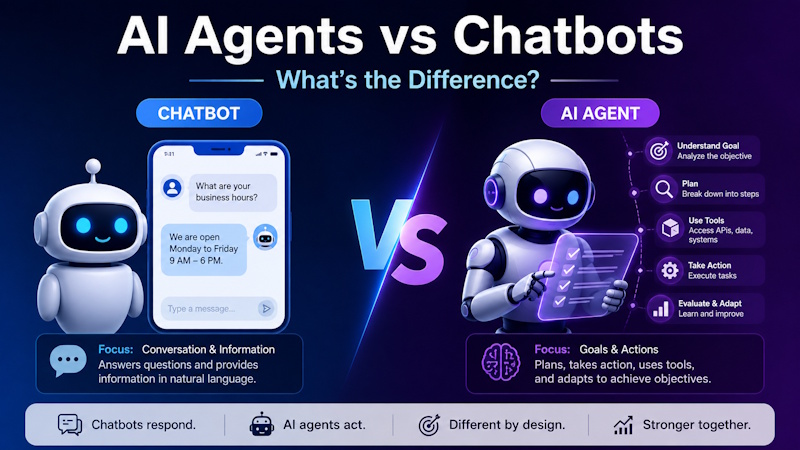
The simplest way to understand the difference is:
A chatbot primarily communicates with you, while an AI agent can potentially take actions for you.
A chatbot generally responds to individual questions or prompts. An AI agent can work toward a goal, plan multiple steps, use external tools, observe the results of its actions, and decide what to do next.
Let's look at AI agents vs chatbots, how they work, and when each technology makes sense.
What Is an AI Chatbot?
An AI chatbot is a software application designed primarily to communicate with users through text or voice.
Traditional chatbots often use predefined rules, decision trees, or scripted responses.
For example:
User: "What time does your store close?"
Chatbot: "Our store closes at 8 PM."
Modern AI chatbots are considerably more capable. They may use large language models (LLMs) to understand natural language and generate flexible responses instead of relying entirely on predefined scripts.
They can help with tasks such as:
- Answering frequently asked questions
- Customer support
- Explaining products and services
- Generating or rewriting content
- Searching a knowledge base
- Providing troubleshooting guidance
- Collecting customer information
However, the primary interaction is still usually:
User asks → chatbot responds.
The chatbot may remember conversational context and retrieve information, but it does not necessarily operate independently toward a larger objective.
What Is an AI Agent?
An AI agent is an AI-powered system designed to work toward a specific goal by reasoning, making decisions, using tools, and taking actions.
Instead of simply answering a question, an AI agent may determine what needs to happen next.
For example, imagine telling an AI system:
"Find a suitable time for our project meeting and prepare an invitation."
A chatbot might explain how to schedule the meeting.
An AI agent with the appropriate tools and permissions could potentially:
- Understand the meeting requirements.
- Check participants' calendars.
- Identify available time slots.
- Select an appropriate time based on predefined rules.
- Create a calendar event.
- Prepare or send invitations.
- Report the result to the user.
The agent therefore moves beyond conversation and becomes part of the actual workflow.
For a more detailed introduction, read What Is an AI Agent? How AI Agents Work.
AI Agents vs Chatbots: Key Differences
Although the technologies can overlap, several characteristics distinguish an AI agent from a chatbot.
| Feature | AI Chatbot | AI Agent |
|---|---|---|
| Primary purpose | Conversation and assistance | Accomplishing goals |
| Interaction | Usually prompt and response | Can perform multi-step workflows |
| Autonomy | Usually limited | Can have higher autonomy |
| Planning | Limited or task-specific | Can plan multiple actions |
| Tool usage | Possible | Often a core capability |
| Decision-making | Usually limited | Can choose actions based on results |
| Memory | Conversation context or stored history | May maintain task and workflow state |
| External actions | Sometimes | Common in agentic systems |
| Adaptability | Responds to user input | Can adapt based on outcomes |
| Best suited for | Q&A, support, information | Automation and complex workflows |
The important distinction is not simply whether an AI system has a chat interface. An AI agent can also communicate through a chatbot-style interface.
The difference is what happens behind that interface.
How Do Chatbots Work?
A chatbot typically follows a relatively straightforward interaction model:
User Input
    ↓
Understand the Request
    ↓
Generate or Retrieve an Answer
    ↓
Return the Response
Traditional chatbots might identify keywords and match them with predefined answers.
Modern AI chatbots can use LLMs, retrieval-augmented generation (RAG), company knowledge bases, APIs, and other systems to provide more useful answers.
Even then, the conversation is usually driven by the user.
If another task needs to happen, the chatbot often waits for another instruction.
How Do AI Agents Work?
AI agents can operate through a more dynamic cycle:
Goal
 ↓
Understand
 ↓
Plan
 ↓
Choose Tool or Action
 ↓
Act
 ↓
Observe Result
 ↓
Evaluate
 ↓
Adjust if Required
 ↓
Complete Goal
For example, suppose an AI agent is asked to research competing software products.
The agent might search approved sources, collect product information, compare features, identify missing information, perform additional research, organize the findings, and generate a final report.
This ability to reason → act → observe → adapt is a major characteristic of agentic systems.
You can learn more about the broader concept in Agentic AI: Complete Guide to AI Agents.
Chatbot Example vs AI Agent Example
Consider a customer who wants to change a flight.
AI Chatbot
The customer asks:
"How can I change my flight?"
The chatbot might explain the airline's change policy and provide instructions or a link to the booking page.
The user then completes the process.
AI Agent
An appropriately authorized AI agent could potentially:
- Retrieve the customer's reservation.
- Check the ticket's change conditions.
- Search available alternative flights.
- Compare options.
- Present suitable choices.
- Change the reservation after obtaining any required approval.
- Update the itinerary.
- Send confirmation.
The chatbot helps the customer understand what to do.
The agent can potentially help execute the task itself.
Exactly what an agent can do depends on its permissions, tools, security controls, and the systems connected to it.
Are AI Agents Replacing Chatbots?
Not necessarily.
Chatbots remain useful because many situations do not require autonomous actions.
If a company receives thousands of questions such as:
- "Where is my order?"
- "What is your refund policy?"
- "How do I reset my password?"
- "What are your opening hours?"
a chatbot may be exactly what is needed.
Using a sophisticated autonomous agent for every simple question could add unnecessary complexity, cost, and risk.
AI agents become more valuable when a task involves multiple steps, decisions, tools, or actions.
For example, instead of only explaining a refund policy, an agent might check whether an order qualifies, retrieve transaction details, initiate the approved refund, update the relevant system, and notify the customer.
Can a Chatbot Also Be an AI Agent?
Yes.
This is one reason the AI agent vs chatbot distinction can sometimes become confusing.
"Chatbot" often describes the interface, while "AI agent" describes the system's capabilities and behavior.
A conversational interface could therefore sit on top of an AI agent.
For example, a user might type:
"Find the three support tickets that require urgent attention and prepare responses."
The interface looks like a chatbot.
Behind the scenes, however, an agent might connect to a support platform, retrieve tickets, analyze priority, review relevant customer information, and draft responses.
So an AI agent can have a conversational interface without being merely a chatbot.
AI Agents vs Generative AI
Another common source of confusion is the relationship between AI agents, chatbots, and generative AI.
Generative AI refers broadly to AI systems capable of generating content such as text, images, audio, video, or code.
A modern chatbot may use generative AI to produce its answers.
An AI agent may also use a generative AI model for reasoning, interpreting instructions, planning, and generating content.
But an agent adds another important layer:
action.
A simplified way to think about the relationship is:
- Generative AI: creates content.
- AI chatbot: communicates with users.
- AI agent: works toward goals and can take actions.
Real-world AI applications increasingly combine all three.
When Should You Use a Chatbot?
A chatbot is usually suitable when the primary goal is conversation or information delivery.
Common chatbot use cases include customer FAQs, internal knowledge assistants, product guidance, basic troubleshooting, educational assistants, website support, and conversational search.
Chatbots can also be easier to implement and control when the system does not need permission to modify external applications or business data.
When Should You Use an AI Agent?
AI agents become useful when the objective involves performing work across several steps.
Potential AI agent use cases include:
- Researching information from multiple approved sources
- Automating repetitive business processes
- Managing support workflows
- Monitoring systems and responding to events
- Assisting software development
- Working with CRM or enterprise applications
- Coordinating schedules
- Analyzing information and producing reports
- Executing approved tasks across multiple tools
However, increased autonomy also requires stronger safeguards.
Organizations need to consider authentication, permissions, data privacy, human approval, monitoring, audit logs, error handling, and limits on what an agent is allowed to do.
AI Agents vs Chatbots: Which Is Better?
Neither technology is automatically better.
The right choice depends on the problem.
Choose an AI chatbot when you mainly need users to ask questions, retrieve information, receive guidance, or interact conversationally.
Choose an AI agent when you need the AI system to work toward an objective, perform multiple steps, interact with tools, and take controlled actions.
In many applications, the best solution may combine both.
Users can communicate through a familiar chatbot interface while an AI agent handles more complex tasks behind the scenes.
Frequently Asked Questions
What is the main difference between AI agents and chatbots?
The main difference is that chatbots primarily focus on conversation, while AI agents are designed to work toward goals and can potentially plan tasks, use tools, make decisions, and take actions.
Are ChatGPT-style assistants AI agents?
Not automatically. A conversational AI becomes more agent-like when it can independently plan tasks, use external tools, take actions, evaluate results, and continue working toward a goal.
Are AI agents more advanced than chatbots?
AI agents generally support more complex workflows and higher levels of autonomy. However, a chatbot may still be the better solution when the requirement is simply answering questions or providing information.
Can AI agents work without human intervention?
Some AI agents can perform certain tasks with limited human involvement, but the appropriate level of autonomy depends on the application. Sensitive or high-impact actions may require human approval.
Do AI agents use large language models?
Many modern AI agents use LLMs for understanding instructions, reasoning, planning, and communication. However, an agent typically combines the model with additional components such as tools, memory, APIs, workflow logic, and security controls.
Will AI agents replace chatbots?
AI agents are unlikely to completely replace chatbots. Instead, chatbot interfaces are increasingly likely to be combined with agentic capabilities, allowing users to communicate naturally while AI systems perform more complex tasks behind the scenes.
Final Thoughts
The difference between AI agents and chatbots comes down primarily to what the AI system is designed to accomplish.
A chatbot is primarily built to communicate.
An AI agent is designed to pursue a goal and take actions.
Modern AI systems are increasingly blurring the boundary between the two. A chatbot can provide the conversational interface while an AI agent handles planning, tool usage, decision-making, and workflow execution in the background.
As Agentic AI develops, this shift from AI that simply answers questions to AI that can help complete tasks is likely to become an increasingly important part of business automation and software development.
Comments (0)